While I was looking at my past research, I thought I still did not understand some main points of wing design. Even though some of my sources talked about them, I never really looked through them, and after looking through several physics forums on wing design while researching what to do for another research project, some familiar yet barely-touched-on topics appeared, such as angle of attack and basic fluid dynamics. So, I did some research on those topics.
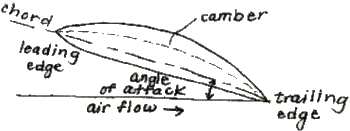
Figure 2: Typical Airfoli (Cross-Sectional Shape) of An Airplane Wing
Chord:
Extends from leading edge to trailing edge of the wing
Camber line:
Points halfway between chord and upper wing surface
Angle of attack:
Angle between direction of airflow and the chord
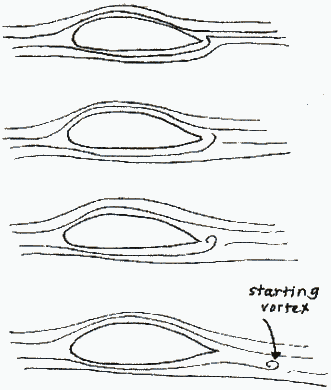
Viscosity is essential in generating lift. The effects of viscosity lead to the formation of the starting vortex (see Figure 4), which, in turn is responsible for producing the proper conditions for lift.
Figure 4: Starting Vortex Formation
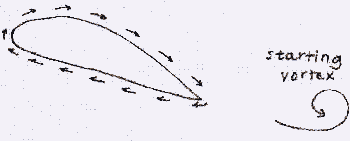
As shown in Figure 4, the starting vortex rotates in a counter-clockwise direction. To satisfy the conservation of angular momentum, there must be an equivalent motion to oppose the vortex movement. This takes the form of circulation around the wing, as shown in Figure 5. The velocity vectors from this counter circulation add to the free flow velocity vectors, thus resulting in a higher velocity above the wing and a lower velocity below the wing (see Figure 6).
Figure 5: Circulation of Air Around Wing
Figure 6: Vector Addition Results in a Lower Velocity Below The Wing and a Higher Velocity Above The Wing (WOAH SO COOL)
I found these graphics to be pretty awesome and just what I needed.
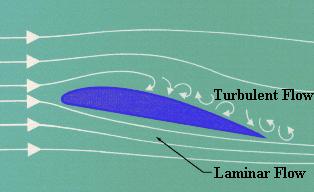
Laminar Flow is the smooth, uninterrupted flow of air over the contour of the wings, fuselage, or other parts of an aircraft in flight. Laminar flow is most often found at the front of a streamlined body and is an important factor in flight. If the smooth flow of air is interrupted over a wing section, turbulence is created which results in a loss of lift and a high degree of drag. An airfoil designed for minimum drag and uninterrupted flow of the boundary layer is called a laminar airfoil.
This is a video I found demonstrating the flow:
At 00:56, it's pretty cool how you can see the flow being disrupted when the pilot stalled!
This website shows the connection between laminar flow and viscosity:
I really like the concept of this post, as a refresher for both yourself and any readers. This is a great method of focusing your project and it seems like you are enjoying what you are learning!


I really like the concept of this post, as a refresher for both yourself and any readers. This is a great method of focusing your project and it seems like you are enjoying what you are learning!
ReplyDelete